
There’s a growing conversation in tech and policy circles about what truly makes a digital platform a public good. As someone who has worked for decades at the intersection of education technology, equity design, and open innovation, I believe this question is critical. Digital public goods are the foundation for trustworthy, accessible systems – and we need to be clear about the checklist of qualities they must embody to deserve that title.
%202.jpg)
In my view, a true digital public good should have several key characteristics:
- Open Source & Transparent: The code is open for anyone to inspect, use, customize, and improve. This not only builds trust (no “black box” algorithms) but also invites a community of contributors. Open-source projects ensure that no single organization owns the technology, preventing customer lock-in and encouraging shared benefit.
- Radically Accessible (No Paywalls): It must be free for anyone to use. Public means that it belongs to the people – there are no license fees or subscription tolls to access basic functionality. This “radical accessibility” lowers barriers for schools, governments, learners, and everyone everywhere. If a tool charges users or restricts core features behind a paywall, it’s not a public good in the genuine sense.
- Interoperable by Design: True public goods are built on open standards and protocols so they can work across different systems – much like how email or the web connects everyone via common protocols. Interoperability ensures a tool isn’t a silo; instead, it facilitates positive network effects. For example, using internationally recognized standards (such as W3C’s verifiable credentials in the case of digital learning records) allows multiple platforms to exchange data seamlessly. This way, users retain control and portability of their information, and no one platform can trap the data.
- Federated & Community-Governed: Rather than control by a single vendor, the project’s governance is federated or multi-stakeholder. This could mean an open consortium, foundation, or decentralized network guiding its development. Community leadership and transparent governance structures keep the project aligned with the public interest. Decisions aren’t made to maximize profit for one company, but to maximize value for all users. (In practice, this might involve open councils, community votes, or non-profit stewardship.)
- Not Profit-Driven The core infrastructure is provided as a public service, not as a means to extract revenue. In other words, income isn’t generated by charging for basic use of the platform or by exploiting user data. Instead, any monetization can happen through optional value-added services on top – built on the public good, not embedded within it. The base layer remains free and open. This flips the typical script: private companies are encouraged to innovate on top of the open infrastructure, rather than owning the foundation outright.
- Equitably Designed: Although not always considered as a requirement of public goods, I would argue that designing first for those that are the most underserved is a requirement, if we are to create a good that is effective and accessible for everyone.
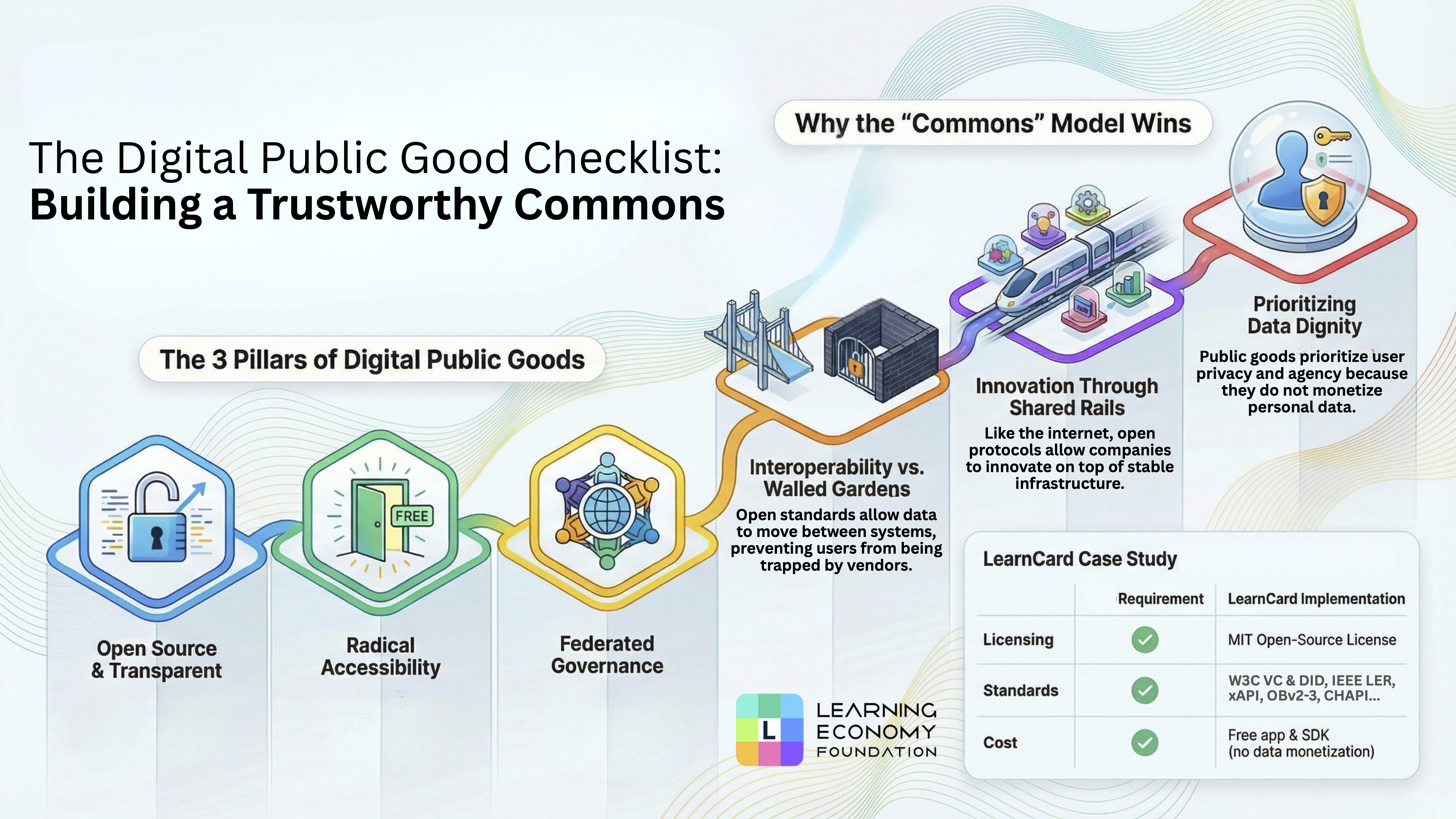
Why do these principles matter so much? Because when digital infrastructure meets all these criteria, it tilts the balance of power and access in favor of the public and creates a sustainable solution. An open, interoperable system that anyone can use and improve creates a rising tide for innovation. We’ve seen it with the internet itself – open standards like HTTP, HTML, SMTP, and TCP/IP became universal public goods, enabling countless enterprises to build successful products and services without needing to reinvent or monopolize the core protocols. The result was explosive growth and creativity, all while the base protocols remained free and non-proprietary.
In the education and workforce context, the same dynamic is possible: if credentials, learning resources, and data exchange are built on public-good platforms, learners and educators can benefit from an ecosystem of interoperable tools rather than being locked into one vendor’s walled garden. It ensures that equity and agency for users come first, not just commercial interests.
Another benefit of true public goods is durability and trust. When a tool is open to all, community-led, and not beholden to a single organization’s business model, it’s more likely to be around for the long haul and to prioritize ethical considerations. For instance, many commercial edtech platforms struggle with incentives to monetize personal data or restrict access to hit revenue targets. Public goods flip that incentive structure. They prioritize user privacy, data dignity, and broad access by design. This builds trust among users (students, teachers, institutions) that the tool exists to serve them rather than to surveil or exploit them.

Ultimately, digital public good isn’t just a buzzword or a box to check – it’s a commitment to a different way of building technology. It means designing for collaboration over competition, and for empowerment over profit maximization. In education technology, this philosophy is especially important: if we get it right, the core infrastructure for learning and credentialing can be as universal and empowering as the internet itself, instead of becoming a patchwork of closed platforms. I would argue that we are currently at a tipping point in this space - we either need to align and move forward collectively, or we will reconstruct the same data and learning silos we have struggled with for decades.
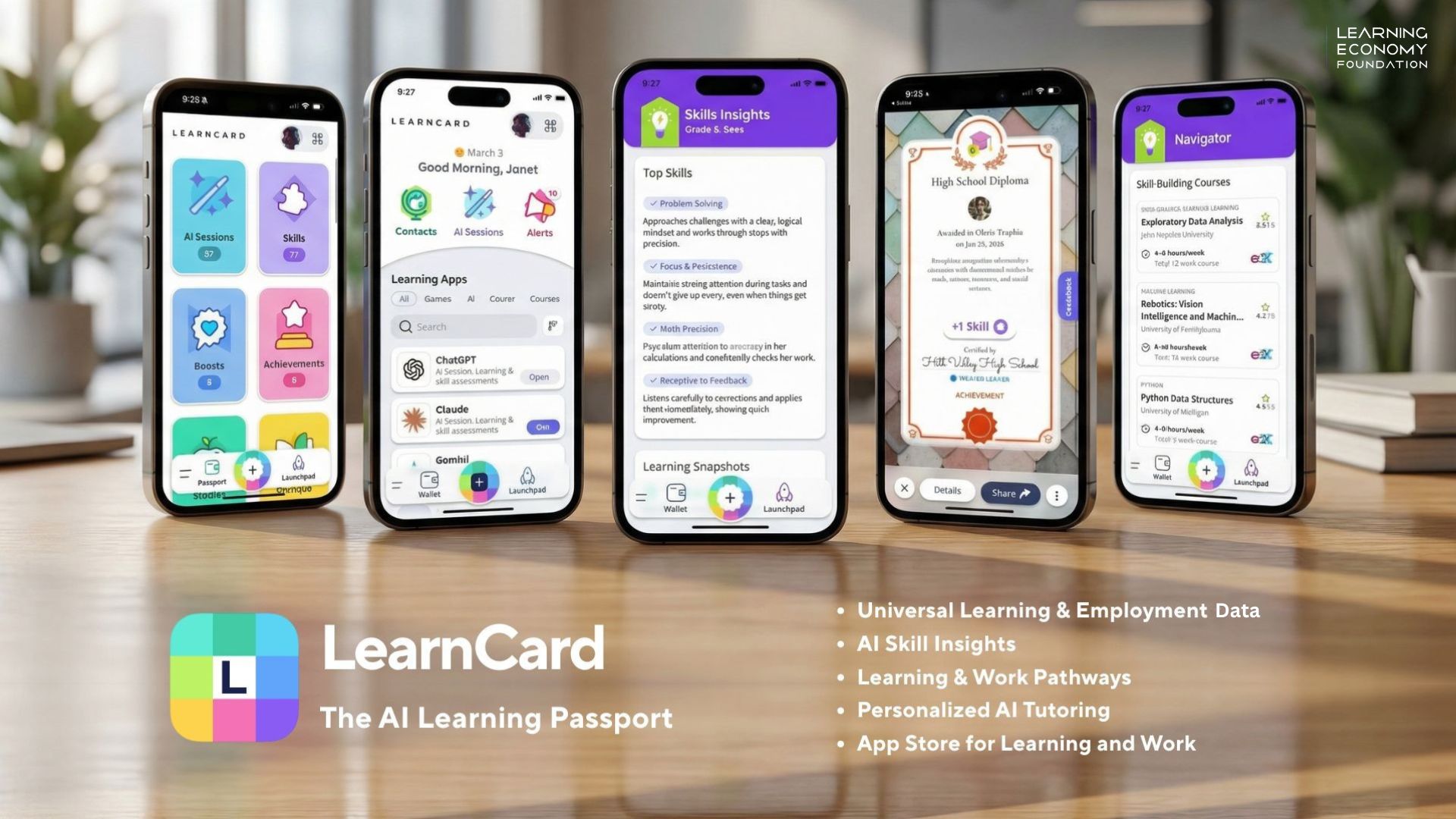
I’m proud to say that the work our team at Learning Economy Foundation has been working on - our lifelong learning passport, LearnCard - is built on exactly these public good principles.
LearnCard is:
- Fully open-source. LearnCard is a digital wallet for learning and employment records that has been architected as a digital public good from day one. It’s released under the permissive MIT open-source license and available completely free of charge – anyone can use the wallet app (currently on web, iOS, Android) or integrate the SDK without paying a cent. And we are working on low- and no-tech versions to make sure that we address digital equity.
- Standards-based and interoperable by design. It uses decentralized identity standards (DIDs) and verifiable credential formats defined by the W3C, so that credentials issued and stored with LearnCard can be read and trusted across different platforms. In practice, that means a university’s system and an employer’s system, for example, can both recognize a learner’s credential from their LearnCard, just as any email provider can send to any other. We’ve made it system-agnostic and extensible, so others can build plugins and connect it to their own platforms easily – no proprietary lock-in.
- Community-driven Roadmap. LearnCard is stewarded by the Learning Economy Foundation (a 501c3 nonprofit) in collaboration with a global coalition of partners, rather than owned by any single company. In fact, when we launched the Lifelong Learning Passport initiative at the United Nations General Assembly this week, we did so with a coalition of over 50 organizations (from foundations and governments to edtech companies and NGOs) to champion a shared global public good for education. This kind of broad partnership highlights how LearnCard isn’t just for the community, but built with the community. We’re embracing a federated governance model: input from diverse stakeholders guides the roadmap, and the aim is for the network to ultimately function as a self-governing, decentralized ecosystem, much like the internet.
- Free to Use (FOREVER). We have no interest in ever charging users to access their own learning records or in turning learner data into a product. Instead, our sustainability model focuses on support services, integrations, and value-added applications that can be built on top of the open infrastructure and will be used to support the public good in perpetuity. The core will always remain free and open. We firmly believe that public-good infrastructure should underlie the learning ecosystem, with commercial innovation layering on top in a healthy marketplace. In other words, you might see edtech vendors offering premium analytics or specialized applications that use LearnCard under the hood – and that’s great – but LearnCard’s base capabilities (issuing, storing, sharing credentials) will always be free and open to all. This approach ensures that learners and institutions are never trapped or taxed for using the “basic rails” of the system. It also incentivizes continuous improvement of the core platform by a broad community, since everyone benefits from a stronger commons.
Calling something a digital public good carries a high bar: open-source, freely accessible, interoperable, community-governed, and non-extractive. Meeting that standard is challenging, but it’s also incredibly rewarding and impactful. When we succeed, we create technology that truly serves everyone – learners, educators, employers, communities – rather than just serving a company’s bottom line.

LearnCard is one example of what’s possible when we hold ourselves to these principles. My hope is that more projects in education and beyond adopt this public-good model, and that as a community we continue to demand it. After all, the problems we’re trying to solve in learning and workforce development (and indeed in many sectors and across the SDGs) are global, systemic, and human-centered. They deserve solutions that are built as public goods – openly, collaboratively, and for the benefit of all.


