
When governments talk about infrastructure, the conversation usually turns to roads, ports, power grids and broadband. These are the systems a country builds once, maintains for decades, and expects everything else to run on.
On the final day of the 81st UN General Assembly, on the SDG Media Zone stage at UN Headquarters, the Learning Economy Foundation made the case that education belongs on that list. It should be designed, financed and governed with the same seriousness.
The argument is a practical one. Among the Sustainable Development Goals, education is the one that enables the rest. A person who can learn, prove what they know and turn it into income is better placed to escape poverty, stay healthy and take part in civic life. Yet in most countries the pieces of an education system were built separately. Schools, training providers, employers, credentialing bodies and social protection programmes each keep their own records and measure their own outcomes.
As a result, a young person can complete a course and still have no way to show an employer what they learned, and no clear route from that course into work.
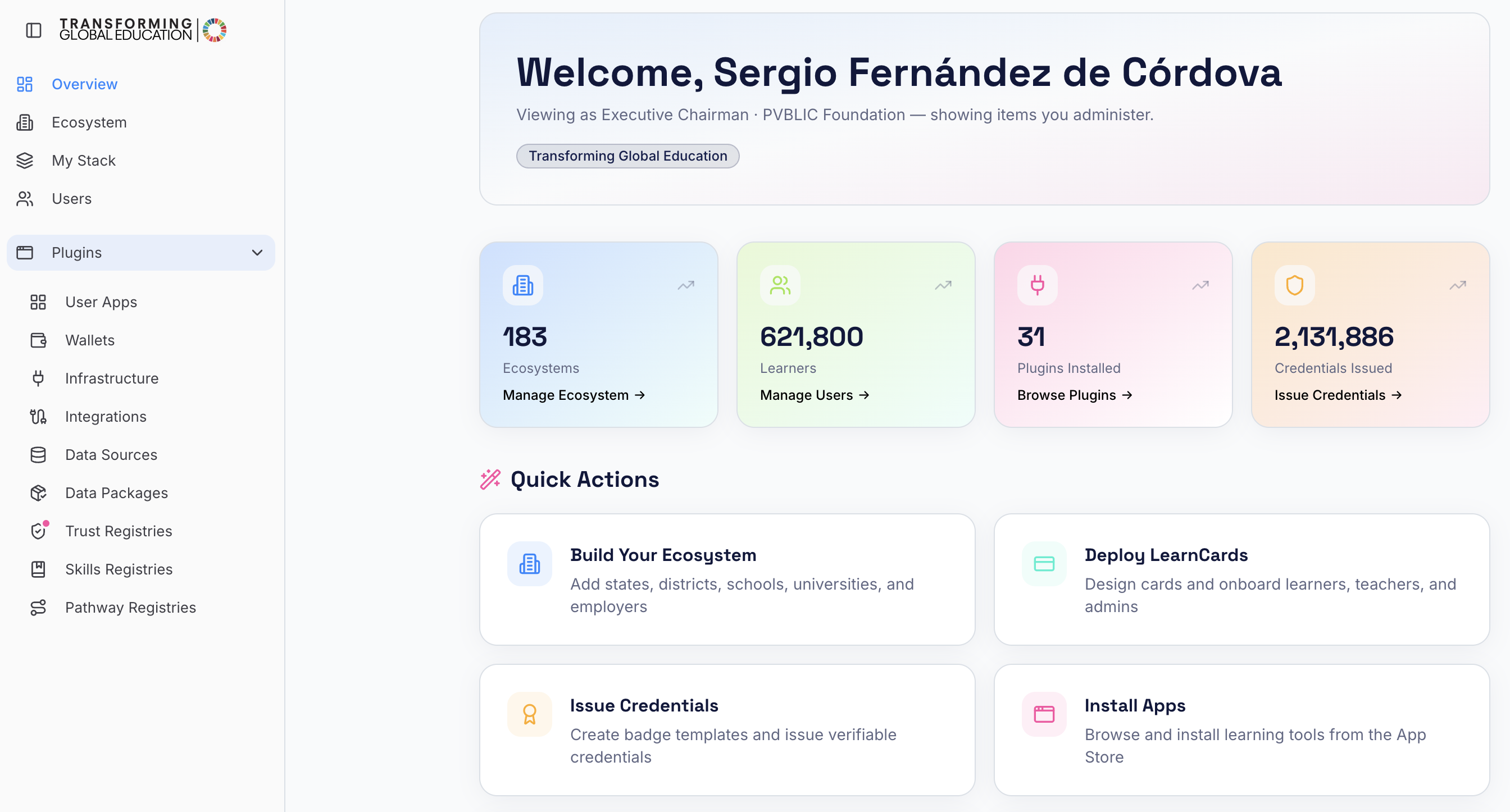
EducationOS, which LEF launched at the UN that morning, as part of the Transforming Global Education program with PVBLIC Foundation, is designed to connect those pieces. It works much like a computer's operating system. A ministry, state or district sets up its own environment and arranges it in layers, so that permissions and data move cleanly between national, local and institutional levels. On top of that foundation it installs what it needs:
- learning tools, including AI
- digital wallets in which learners hold their credentials for life
- shared data standards
- connections to the school and training systems already in use
Each country assembles the configuration that fits its own priorities. Because EducationOS is a public good, the system serves the people who use it rather than sitting inside a single vendor's platform.
Two of the program's keystone partners showed how different those priorities can be. Dr. Bernard Doro, Nigeria's Minister of Humanitarian Affairs and Poverty Reduction, sees education as the way to graduate people out of poverty. For that to work, he argued, learning has to meet three conditions. It must start from what young people actually need and care about. It must be flexible enough to reach them through technology. And it must lead to economic activation, not just a certificate to be framed and hung on a wall.
Tonga's Minister of Finance, who oversees a budget in which education is the largest line, faces a different geography: roughly 700 square kilometres of land scattered across 700,000 square kilometres of ocean. Tonga's priorities are equal access for every child regardless of island, a clearer path from classroom skills to the labour market, and global qualifications that leave young Tongans grounded in their own values.
Nigeria is where the work has advanced furthest. The work sits within Minister Doro's OHOPRS social intervention design, through an initial Education-to-Livelihood programme developed with IQS. Following a successful pilot with a group of young women and youth, an ambitious three-year effort to reach 22 million people nationwide will begin. If the program meets its initial milestones, the World Bank has committed $500 million to support its expansion across the country. Its training is tied to real employer demand, and LearnCard-enabled pathways are already being tested with VARCE and the United Nations International School.
Over the next year, Nigeria and Tonga will produce case studies from two very different systems: a large African economy and a small island developing state. If the model holds in both, other governments gain a tested way to run learning, employment and social protection as one connected pathway.
The young leaders who spoke that same morning offered the right measure for all of it. Systems like this should be built with young people from the start and they should be judged by whether learners leave with the knowledge, opportunity and confidence to shape their own futures.


